





Eye For Film >> Movies >> What Happened To Doris? (2026) Film Review



“The following motion picture is based on true events,” says the legend at the start of Nick Simon’s latest, and that’s a bold statement if ever there was one.
Parts of it are undoubtedly true. Doris Bither was a real person who lived in Culver City, California, in 1974. In August of that year she began telling people that she experienced traumatic paranormal activity in her home, and she subsequently persuaded members of the Parapsychology Department at the University of California to investigate it. The results of that investigation, however, remain heavily contested. Still, whatever you think about the supernatural or the ethics of misleading a cinema audience in that way, it has to be acknowledged that this is a stonker of a film.
It doesn’t struggle to compete with the only previous cinematic adaptation of the story, Sidney J Furie’s woeful 1982 melodrama. Perhaps it helps that Bither herself has since died and investigator Barry Taff, who advised on that production, are no longer around to insist on their version of realism. Simon, and writer Thomas Fenton, have been free to exercise their imaginations, and the result is something with considerably more flair. It is also, surprisingly, a film with more astute social subtext, capable of resonating with an audience on multiple levels.
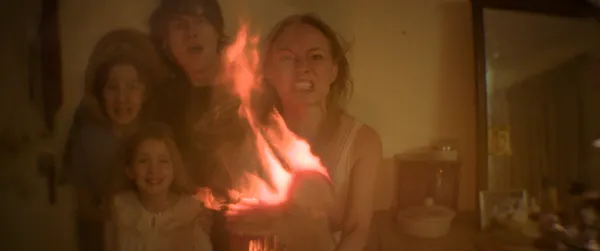
Bither, this time around, is played by Heather Graham, an actor who has really come into her own over the past few years. Here all the failings of Killing Me Softly and her wilderness years are forgotten, with the promise that she showed in the likes of Boogie Nights shining through. Though she looks nothing like Bither, she very effectively captures the personality remembered in surviving descriptions, and until Barbara Hershey in the previous interpretation, doesn’t waste effort trying to justify or sanitise her. Doris is what she is: an imperfect witness with a history of alcoholism and substance abuse, yes, but still a human being who, whatever the truth of her claims, has clearly experienced trauma and deserves to be treated with care and respect. Graham sells this, makes us believe in her suffering, and also makes her someone who is easy to like. Not just an object of pity, she comes across as brave, witty and extraordinarily resilient.
Bither was a mother of four; here that is reduced to three, because that’s all we really need to make the story work. There is the teenage son (Daniel Reed Ferrell) whom she strives to keep in line at the same time as looking to him for help; the tweenage boy (Kayden Alexander Koshelev) awakening to adulthood at the same time that his home becomes a psychic battleground; and the young daughter (Island Austin) who, in line with movie tradition, starts to see and sense otherworldly things before anyone else. The four of them live in a little yellow bungalow, the boys unhappily sharing a bedroom, and it’s crowded in the way of homes whose residents can’t risk throwing things away because they wouldn’t be able to buy replacements if they needed them again. Officials look at its disorder as if it were a moral failing. Lone parents will look on it with more sympathy. In this world there is no overlap. We are quickly reminded that an unmarried mother in the Seventies was seen as unreliable in most regards.
What Graham’s version of Doris does have on her side is a loyal friend, Kandy (Candi Marie), who is better at making herself heard. This is California, so Kandy is open to the possibility that Doris’ account of psychic phenomena is real, and she’s also practical enough to look for a way to do something about it. This begins with taking her to an occult bookshop, and a recreation of a real encounter with the aforementioned academics, who are initially sceptical but soon enough witness something for themselves that is exceedingly difficult to explain. The story then picks up pace as they endeavour to understand the phenomena and, if possible, put an end to them before Doris and her family come to any more serious harm.
The original haunting phenomena are considerably simplified here and the film is stronger for it. Simon confidently marries the investigative and horrific aspects of the story, and very effectively combines sudden scares with the gruelling horror of a problem that won’t go away. The family’s poverty dramatically limits their choices, making them much more vulnerable than the protagonists of most similarly themed tales, and this, combined with the weight of all that sexism and class prejudice, forms the bedrock of a whole extra layer of real world horror. It also grounds the film and Doris’ response. For her, this is just one more indignity in a life that has been full of them.
All this detail, backed by capable performances, ensures that the film is absorbing throughout. It turns a simple shocker into something more profoundly tragic. The semiotics of ending with Donovan’s Hurdy Gurdy Man will not have been lost on its initial Fantastic Fest audience, and there’s a grim postscript to accompany that. You may or may not buy the whole of the ‘true story’ behind it, but by the end, you will believe in Doris.
Reviewed on: 21 Sep 2026


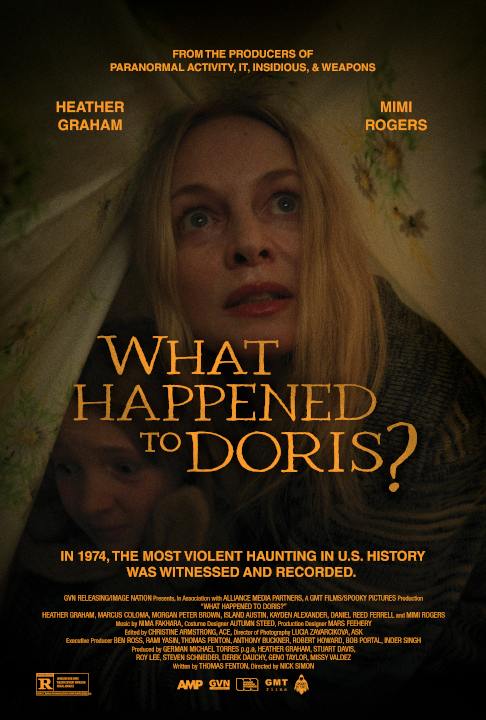
Director: Nick Simon
Writer: Thomas Fenton
Starring: Heather Graham, Candi Marie, Mimi Rogers, Island Austin, Marcus Coloma, Luke Baines, Kevin Keppy, Kayden Alexander Koshelev
Year: 2026
Runtime: 92 minutes
Country: US
Search database:
